


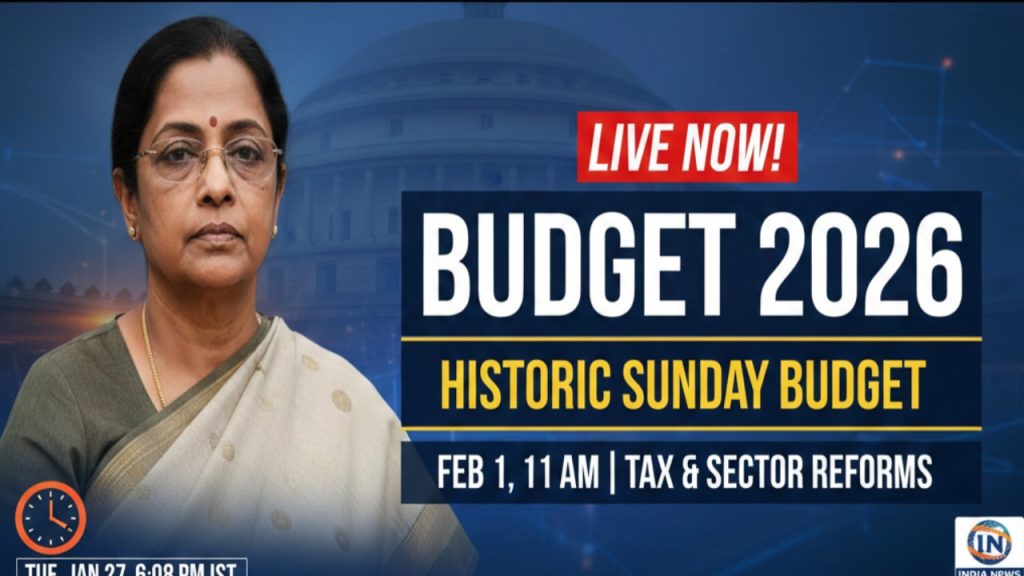
New Delhi: Finance Minister Nirmala Sitharaman is set to make history on February 1, 2026, by presenting the Union Budget on a Sunday for the first time in India’s parliamentary history. This will be her ninth consecutive budget, bringing her closer to the all-time record of ten held by Morarji Desai.
As the nation awaits the financial blueprint for FY 2026-27, here is a complete guide to the schedule, historic shifts, and what taxpayers and industries are expecting.
1. Key Dates & Schedule: The “Sunday Budget” Timeline
The Budget Session will be conducted in two phases, starting with the President’s address.
- January 28: Budget Session begins with President Droupadi Murmu’s joint address to both Houses.
- January 29: FM Sitharaman will table the Economic Survey 2025-26 at 11 AM, providing a comprehensive state of the economy.
- February 1 (Sunday): The Union Budget 2026 will be presented at 11 AM in the Lok Sabha.
- February 13: The first phase of the session concludes.
- March 9 – April 2: The second phase of the session for detailed debates and passing of the budget.
Market Note: Despite it being a Sunday, the NSE and BSE will remain open for a special trading session (9:15 AM to 3:30 PM) to allow markets to react to the announcements.
2. Income Tax Expectations: Relief on the Horizon?
With the New Income Tax Act, 2025 scheduled to take effect on April 1, 2026, taxpayers are looking for clarity and further relief.
- Standard Deduction Hike: Experts and industry bodies like AMCHAM India have proposed raising the standard deduction from ₹75,000 to ₹1.5 lakh to offset rising living costs.
- New Tax Act Clarity: Stakeholders expect the budget to provide a roadmap, transition rules, and detailed FAQs for the New Income Tax Act to minimize litigation and confusion.
- TDS Rationalization: There is a strong push to streamline the Tax Deducted at Source (TDS) structure into just three or four simplified rates.
- Savings & Insurance: The insurance sector is seeking higher tax incentives for pure protection products (like term life insurance) to be separated from savings-linked plans.
3. Sectoral Spotlight: What’s in the Box?
Industry leaders across various sectors have submitted their “wish lists” to the Finance Ministry:
- Infrastructure: Central government capital expenditure is expected to cross ₹12 lakh crore in FY27, a roughly 10% year-on-year growth. Experts suggest a shift toward “lifecycle performance” and durability of assets rather than just spending volume.
- Defense: In light of global tensions, a higher capital outlay for domestic defense production is expected to reduce import dependency.
- Deep-Tech & AI: Startups are eyeing R&D tax credits and incentives for AI, robotics, and cloud infrastructure to position India as a global innovation hub.
- MSMEs: Small businesses are seeking easier access to credit, GST rationalization on key inputs, and support for digital transformation.
- Real Estate: The industry is hopeful for “Infrastructure Status” for the sector and an expansion of the “affordable housing” definition to the ₹75–90 lakh bracket.
4. Why the Change? Breaking Colonial Traditions
The 2026 Budget continues the trend of modernizing India’s fiscal processes:
- Morning vs. Evening: Until 1999, the budget was presented at 5 PM to suit British time zones. Yashwant Sinha shifted it to 11 AM to prioritize domestic governance.
- February 1 vs. End of February: In 2017, the date was moved from the last day of February to the first to allow policy implementation to begin exactly on April 1, the start of the new fiscal year.
5. How to Watch the Budget Live
The presentation will be broadcast live starting at 11 AM on February 1, 2026, via:
- Sansad TV (Official Parliament Channel)
- Official Website: www.indiabudget.gov.in
- Major news outlets and social media platforms like YouTube and X (formerly Twitter).